At many universities, the first time someone from outside puts in writing how a student works in a team, how they communicate or how they take criticism is at the end of their internship. It is done by the supervisor at the host organisation, on a form, once the period is over. By then, what that report uncovers can no longer be worked on in the classroom.
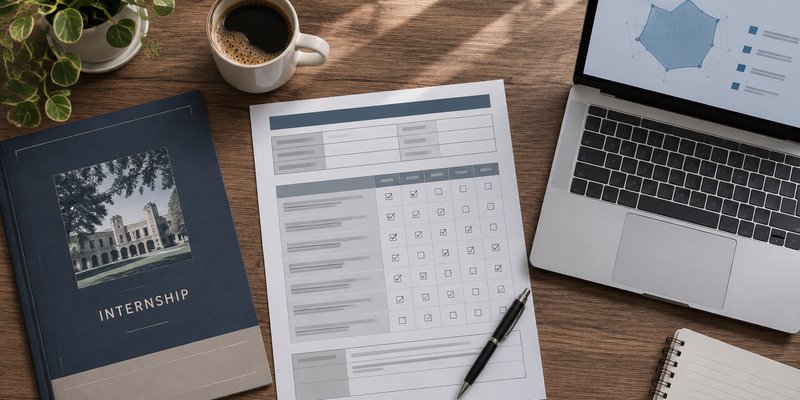
It is not an arbitrary habit. In Spain, Royal Decree 592/2014, which regulates external academic internships, provides in its Article 13 that the supervisor at the partner organisation sends a final report to the academic tutor. In it they may rate technical ability and capacity to learn, oral and written communication, sense of responsibility, adaptability, creativity and initiative, openness to criticism, relationships in the workplace and the ability to work in a team, among other aspects. Almost the whole list is soft skills.
Internships carry more and more weight in hiring
That moment matters because, for many companies, internships have become the most reliable selection filter. The National Association of Colleges and Employers (NACE), which surveys employers in the United States every year, reported in April 2026 that the conversion rate of interns into hires reached 63.1 % for the 2024 to 2025 class, the highest in five years. The survey covers 284 organisations.
With the same data, NACE showed in May that those who interned at the company stay longer: more than three quarters are still there after one year and more than half after five. Among those who had no internship experience at all, fewer than half remain after the first year and about a third after five.
For a company, an internship works as a long, cheap observation period. For the student, it is often the way into their first job. And for the university, it is where a good part of its reputation with employers is at stake.
The problem with assessing only at the end
If the competencies that weigh most are measured for the first time when the internship ends, the university is late twice. It is late for the student, who finds out that they struggle to delegate, or that they freeze in front of a difficult client, when there is no longer a course in which to correct it. And it is late for the institution itself, which receives a valuable but isolated report, written by a different person at each company, with criteria that do not always match.
There is a third, less visible effect. When nobody has observed those abilities beforehand, placements are assigned with the only thing available: the academic record and an interview. So a student with good grades and little ease in working with others can end up in a demanding internship with no prior support, and another with a great deal of practical judgement can miss out on the company that suited them best.
Bringing the assessment forward into the classroom
We have spent ten years working with more than 20 universities and business schools on a simple idea: practise, assess and accredit before the student goes out to the company. In practice, that comes down to three pieces.
A simulation that forces decisions with others. In a business simulation, a team runs a company over several rounds: it sets prices, allocates budget, hires, negotiates. The consequences build up and every decision is recorded. It is a safe environment for getting things wrong, but it is not a game without cost: if the team cannot agree or someone does not do their part, the results show it. That is where many of the aspects the company supervisor will later rate appear, with concrete examples: initiative, responsibility, adaptability and teamwork.
A 360° peer assessment. When the simulation ends, each student assesses themselves and receives the views of those who worked with them, on observable behaviours and not on general impressions. The comparison between how one sees oneself and how others do tends to be the most useful part of the exercise. From there the instructor can propose specific goals for the internship period.
Evidence that travels with the student. The result should not stay as a grade. A short report stating which competencies were observed, by what method and at what level helps the internship office guide the assignment of placements, the academic tutor follow up, and the student present themselves to the company with something more than an academic record.
How to start without changing the curriculum
There is no need to create a new course. It works well to choose a course in the year before the internship, with groups already formed, and to bring into it a simulation lasting several weeks with a peer assessment at the end.
It helps to use as a reference the same list the company supervisor will fill in later. If the final report is going to ask about openness to criticism or teamwork, it makes sense for the student to have received feedback on those same abilities beforehand. That way the company's report stops being the first measurement and becomes the second, comparable with the one before.
Finally, close the loop. When the supervisors' reports arrive, comparing their ratings with those from the classroom says a lot about which competencies are being developed well and which are not, information that is also useful before accreditation agencies.
We discuss how to make competencies leave a trace in the company in From training hours to evidence, and the practise, measure and accredit approach in our CLADEA 2026 recap. If your university already assesses soft skills before the internship, we would love to hear how you do it.